The Grassroots Revival Fuelling British Snooker
Anyone under the notion that the UK lacks new snooker talent would have instantly changed their mind with a visit to the first event of the English Junior Tour season in Leeds last month.
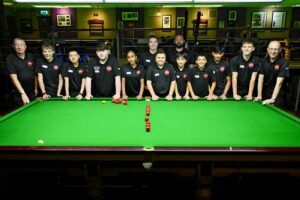
The event had 73 players (pictured below) and after two days of intense competition at the Northern Snooker Centre the trophy was lifted by 17-year-old Vladislav Gradinari, beating 18-year-old Daniel Boyes in the final.
In many areas of the UK the amateur scene is thriving, with a multitude of tournaments on the calendar. In England alone each season there are seven national tours and 12 national championships, including events for under-14s, under-16s, under-18s, under-21s, older amateurs, seniors, women, disability, league snooker and billiards players, all organised by the English Partnership for Snooker and Billiards.
The EPSB has seen its total membership increase by 24.2% since 2022 and over that time the total prize money paid out at its events has more than doubled to over £50,000. Each year, a dozen of the most promising players are selected for the Elite Junior Development Programme, which aims to equip them with the skills on and off the table to maximise their potential during their snooker career.

“The calendar is so busy now, I have only one weekend in my diary between now and Christmas without a tournament,” said Gradinari, who is Moldovan-born but has been based in England since 2021 and practises at Levels in Huddersfield. “Even pro-ams often have 100 or more players in them. I have been playing for five years and in that time the standard has got higher and the venues for tournaments and conditions have got much better.
“We play at great clubs like Landywood and the Northern Snooker Centre, and some really good venues on the Q Tour, and we play on brand new cloths. It’s really enjoyable to play in the amateur game, everyone knows everyone and feedback always gets listened to. Snooker seems to be very popular at the moment, the clubs are busy.”
Sanderson Lam, who dropped off the pro tour at the end of last season, concurs as his tournament diary is fuller than ever and he has already won events on the WPBSA Q Tour and English Amateur Tour this season. “I really enjoy having lots of tournaments to play in,” he said. “When you’re competing regularly, you’re constantly under pressure and you get a chance to test your game. And there’s such a variety of clubs you get to play in on the amateur circuit, across the UK and Europe. The more competitive matches I can play, the better.”
While many of the world’s brightest young professionals are emerging from China, the likes of Jackson Page, Stan Moody, Liam Davies, Liam Pullen, Dylan Emery and Oliver Sykes are all demonstrating their potential on the tour. And behind them is a wave of promising young potters, gaining experience week in, week out at tournaments across the UK.

WPBSA Chairman Jason Ferguson, a former world number 28, played on the amateur scene in the UK in the 1980s and 90s. But he insists: “That scene now is better than it has ever been. When I came back into WPBSA 15 years ago it was struggling. Numbers in the English under-14s for example were very low – and that’s the critical age because it’s when players get hooked for life.
“Since then we have invested massively. A lot of clubs have become very family friendly and nice places to go for young people, with good quality facilities. That’s the result of a lot of effort from us and other bodies like the EPSB. And those clubs are doing a lot to increase participation, like staging their own events, open days, running women’s and disability groups.
“We have also invested in coaching and development structures. We needed boots on the ground, getting a lot of people and volunteers out there and giving them the right skills. We made structural changes to our coaching scheme and that has been picked up by other national bodies. There are so many official coaches out there now doing a fantastic job, running Saturday groups for young children, local leagues and qualifying events which feed into the national under-14s. The network has really grown across the UK and the same can be said about many countries across Europe. In terms of the number of entries to junior events we are thriving.”
That growing network is crucial to grassroots development, relying on the dedication of coaches. Back in 2008, there were only eight active official coaches; since then the WPBSA has trained over 1,000 around the world. At the QBAR Snooker Academy in Walsall, Andrew Highfield runs three different junior groups for players of all abilities every Saturday and another on Wednesday evenings. “We also run junior leagues, school holiday camps and we have a team in the West Midlands League – one of the young lads has already made two centuries in matches,” said Highfield, who joined academy owner Fay Tapper in bringing a group of 22 juniors to the Players Championship in Telford last season.
“The interest is growing, I’m 100 per cent sure about that. There are so many young children who just want to give snooker a try. Sometimes they come to the Saturday afternoon group because they play football in the mornings. Then a couple of weeks later they turn up in the morning because they want to play snooker instead of football. And it’s girls as well as boys.”
Encouraged by the recent success of snooker, Ferguson spoke at Sport Accord in Lausanne this month about the challenges sport in general faces in maintaining participation. One potential solution is to communicate to young people on their digital devices: an opportunity to inspire that captive audience. “Most importantly we have invested in technology,” he said. “Our Play Snooker app gives players anywhere in the world the chance to register, find out where their nearest clubs are, meet local players and much more. We have to embrace technology, young people are on their phones so let’s signpost them towards snooker. The pandemic showed us that people still want to get out there and take part in activity.”
It is well documented that many snooker clubs across the UK were forced to close in the early 2000s due to financial pressures, though as this BBC article highlights, those that have survived have modernised and are prospering. “The toughest challenge for us is protecting the facilities, the places where juniors can get started,” Ferguson added. “This is tougher for us than other sports – in football you just need a ball and a piece of grass and you are participating. In snooker you need tables. We need more funding and more protection of clubs and that’s something we are lobbying extensively.”
The big question remains: are there British equivalents to Wu Yize and Chang Bingyu out there? “It will come,” said Ferguson. “China is a massive country, there are cities there with nearly half the population of England. It’s a question of numbers and by comparison, the UK is actually doing well. Look at South Wales, a small area but it has produced so many great players over the years, and now Liam Davies is climbing up the rankings and I can see him being a great ambassador for our sport. The likes of Stan Moody and Liam Pullen are doing well and they are quite a bit younger than Wu Yize or Chang Bingyu so let’s give them time to see what they can do.
“When you look at that English junior event with 73 players, and those are all serious players, it’s clear that the talent pool is there. And it’s inevitable that a few of those will have very bright futures. And it only needs one to become a superstar and inspire a whole nation. When I was young it was Steve Davis – he was my idol and he inspired me to play. That’s the impact Ding Junhui had in China – though even there it took another 15 or 20 years for the next really great players to come along.”